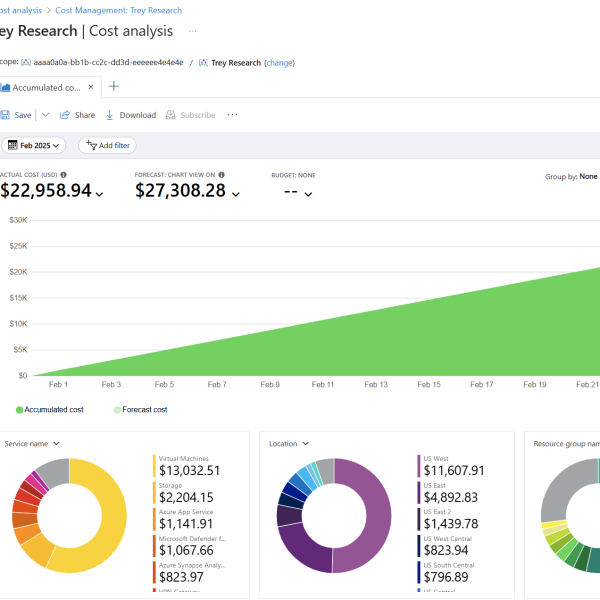
If you signed up for Microsoft Azure with a credit card, you are not alone. Thousands of businesses across Europe do exactly the same — it takes minutes, it works immediately and nobody asks any questions. But at some point, the bill arrives. And it is higher than expected. Or the environment grows in ways that are hard to control. Or a security audit reveals gaps that nobody noticed. This article is for everyone who has been there — or wants to avoid getting there.
Sound familiar?
A developer needs a virtual machine for a new project. A CTO wants to test a service. A startup needs somewhere to host its application. Azure is right there — sign up, enter a credit card, and you are running in minutes. No procurement process, no partner, no questions.
For a while, it works perfectly. Resources get added as needed. The team moves fast. Then, gradually, things get complicated:
- The monthly bill keeps growing — but it is not always clear why.
- Nobody has a clear picture of what is running and what is not.
- Access controls were set up quickly and never revisited.
- There is no one to call when something breaks at the wrong moment.
This is not a failure of Azure. It is a natural consequence of growing fast without a governance structure — and without a partner.
What you are actually paying for — and what you are missing
Pay-As-You-Go is Microsoft’s default model for direct Azure customers. You pay for what you use, billed monthly to a credit card. There are no commitments, no contracts and no minimum spend. It sounds flexible — and it is. But flexibility comes at a cost.
- Pay-As-You-Go rates are the highest available — Microsoft’s list price, with no discounts applied.
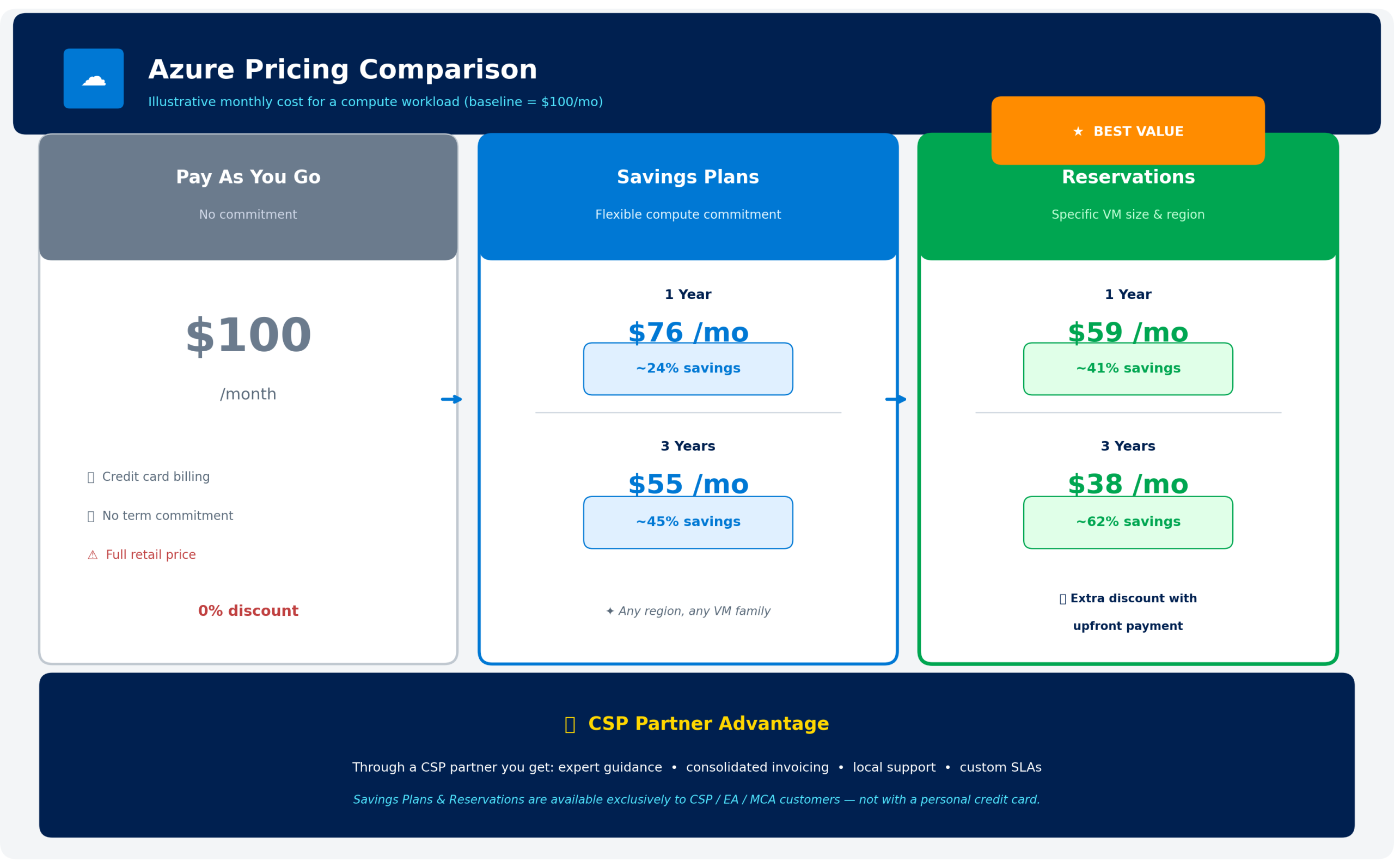
- Reserved Instances and Savings Plans — which can reduce costs by 30–65% — require planning and commitment that most self-managed environments never get around to.
- There is no spending limit by default — a misconfigured resource or a forgotten virtual machine can generate significant unexpected costs.
- Support is not included — beyond basic documentation, resolving a technical issue means opening a ticket and waiting, with no guaranteed response time.
A CSP partner changes all of this. Pricing through a CSP is typically lower than Pay-As-You-Go, and the relationship includes active cost management, spending controls and direct technical support.
The hidden costs of going it alone
The monthly Azure bill is only part of the picture. The real cost of an unmanaged Azure environment often shows up elsewhere:
- Security misconfigurations — open storage accounts, overly permissive identity roles and unmonitored access are among the most common causes of cloud security incidents. Without a partner reviewing the environment, these can go unnoticed for months.
- Wasted spend — idle virtual machines, oversized resources and forgotten services are common in self-managed environments. A cost review typically identifies 15–30% of spend that can be eliminated or optimised immediately.
- No governance — without defined policies, tagging standards and access controls, Azure environments become difficult to manage as they grow. Rebuilding governance later is significantly more expensive than implementing it from the start.
- No escalation path — when something goes wrong, the only option is Microsoft’s standard support queue. There is no partner who knows your environment and can act immediately.
What changes when you work with a CSP partner
Moving your Azure subscription to a CSP partner does not mean losing control — it means gaining a layer of expertise, tooling and support that Pay-As-You-Go does not provide.
- ➡ Lower pricing — CSP partners purchase Azure capacity at partner rates and pass the savings to customers. Combined with Reserved Instances and Savings Plans, the cost reduction can be substantial.
- ➡ Cost management and spending controls — usage thresholds, spending limits, cost forecasts and detailed analytics give you full visibility and control over Azure consumption. No more surprise bills.
- ➡ Dedicated technical support — a partner who knows your environment, responds within defined SLAs and escalates to Microsoft on your behalf when needed.
- ➡ Access to Microsoft funding programmes — FastTrack, Solution Assessment and Azure Migration and Modernization are only available through authorised Microsoft partners. These programmes can significantly reduce the cost and complexity of cloud migrations.
- ➡ Security and governance — a partner reviews your environment, identifies gaps and implements the controls that self-managed environments typically lack.
Is switching complicated?
No. Moving an existing Azure subscription to a CSP partner is a straightforward process that does not affect your running workloads. Your virtual machines, databases, storage and services continue to operate without interruption. The transition typically involves:
- A review of your current environment and spend
- A partner request that you accept in the Azure portal
- Subscription transfer to the CSP model
The entire process can be completed in a matter of days. And from that point, you have a partner — not just a cloud provider.
Already running Azure on a credit card? We will review your environment, identify cost optimisation opportunities and outline what a CSP partnership would mean for your organisation — at no cost.
Book a free Azure assessment →